


“Qumulo doesn't just solve the storage problem—it removes storage as a constraint to AI innovation entirely.”
– John Jacobs, CIO

Unify your edge, data center, and public clouds into a single, strictly consistent global file system. Stop copying data, end version control nightmares, and empower your global teams to collaborate in real time.

Qumulo Cloud Data Fabric provides fast, consistent access to data anywhere, enabling distributed teams to operate on a single, unified view of their data.

Qumulo Cloud Data Fabric, Unified Data Management for the Hybrid Enterprise

Access and collaborate on the same data from anywhere in the world, with low latency and no transfers or sync delays.

CDF maintains a single, authoritative dataset, eliminating the need for replication and multiple copies, reducing costs and simplifying data management.

A globally distributed, strictly consistent file system gives organizations predictable performance, strong governance, and full control over where data lives.
Qumulo Cloud Data Fabric enables instant data access for geographically distributed teams, allowing simultaneous collaboration with strict data consistency and performance that feels local.
As users and applications at one site start working with that data, it builds a dynamic cache that’s shared by all local clients on the local Qumulo endpoint, eliminating a round-trip over the WAN for nearly all access requests and ensuring that users experience low-latency read performance.
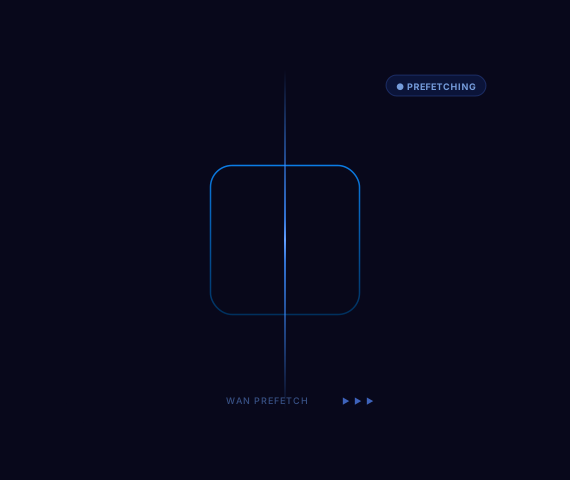
NeuralCache, a feature of Cloud Data Fabric, analyzes file access patterns to predict what data you’ll need next and prefetches it across the WAN. When users or applications request that data, it’s already there.
Any changes made to that same data are committed locally, providing users and applications with low-latency write performance, even as changes are propagated to other locations that share the data.
Cloud Data Fabric uses Qumulo’s patented locking and logging mechanisms to ensure strict consistency for all data, so that no matter when or where a file was last modified, the following user or application to access the same file, even if it’s from a different corner of the world, is guaranteed to see the latest version.
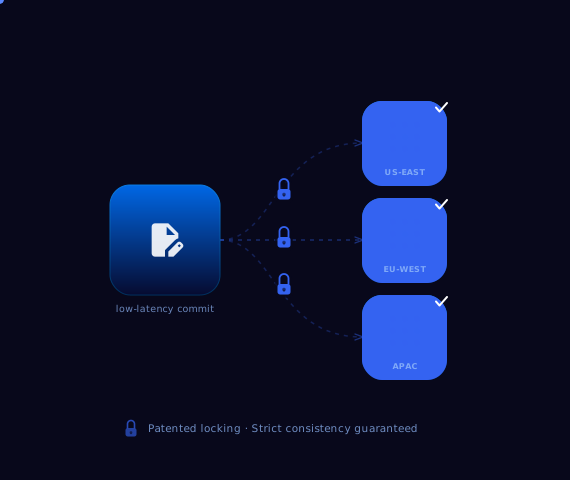
All of this is transparent to users, applications, and administrators. There are no replication relationships to set up and monitor; no risk of version conflicts that can derail workflows and take days to reconcile, and no long waits for the latest data. Cloud Data Fabric simply, seamlessly, and reliably just works.
The Future of Distributed Data: An Introduction to Cloud Data Fabric
“Qumulo doesn't just solve the storage problem—it removes storage as a constraint to AI innovation entirely.”
– John Jacobs, CIO

Qumulo delivered immediate results. We observed stable performance, simplified operations, and the capability to monitor and analyze data in real-time. It was a game-changer.
– Insu Kim, Head of the Data Innovation Center

Never miss a deadline. Qumulo Cloud Data Fabric enables organizations to dynamically expand on-premise burst render capacity by making data available to cloud-based burst compute capacity securely and without replication.
Learn MoreIn hospital and healthcare environments, Cloud Data Fabric (CDF) integrates distributed edge locations, core data centers, and public clouds to unify critical workloads—such as PACS medical imaging, Electronic Medical Record (EMR) caches, video surveillance, and enterprise backups—into a single, highly durable hybrid-cloud platform.
Learn MoreCloud Data Fabric (CDF) provides financial services firms with real-time, low-latency access to market and transaction data across geographically distributed locations while maintaining strict data consistency.
Learn MoreQumulo's Cloud Data Fabric (CDF) fundamentally transforms hybrid cloud architectures by unifying fragmented environments into a single, globally consistent file system that spans on-premises data centers, the edge, and public clouds.
Learn MoreCloud Data Fabric (CDF) optimizes edge workflows by utilizing a hub-and-spoke architecture that unifies distributed edge locations with core data centers and public clouds into a single, globally visible namespace.
Learn MoreNo ticket queues. 24/7 access to engineers who understand AI-driven data access, caching, and large-scale data infrastructure. Real humans. Real answers. Built for performance at scale.
Blog
Data is everything. I’ve said for decades that the ‘network is the platform’, that compute reshapes industries, that storage provides the digital foundation. But the truth – the real truth – is that all of these domains only matter because of the data that flows through them.
Blog
Blog
At AWS re:Invent 2025, one theme stood out clearly: AWS is investing heavily in partners who enable customers to innovate faster, modernize more effectively, and scale globally with confidence.
One Platform. Any Data. Any location. Total Control.
Qumulo Cloud Data Fabric breaks down the technical and economic barriers to sharing data where and when your business needs it, empowering organizations to:
Share data anywhere, on-demand, while maintaining data sovereignty and security.
Rapidly onboard skilled workers and partners globally to enable competitive advantage.
Seamlessly integrate on-premise data with cloud-based storage to enable a true hybrid cloud.
Migrate data and applications to available cloud resources to optimize costs and accelerate application performance.
Qumulo’s Cloud Data Fabric was architected and developed from the ground up to incorporate a geographically distributed high-performance cache, Global Namespace (GNS), Predictive Caching, and Advanced Analytics into the core Qumulo file system.
CDF enforces strict consistency across the fabric instantaneously, which is critical to maintaining application integrity. Qumulo enables organizations to build a seamless data fabric that unifies edge, data center and cloud into a cohesive data fabric. This allows organizations to deploy Qumulo Cloud Data Fabric in the cloud or the data center, and expand to include other cloud services, edges or data centers later.
Organizations can use CDF to share data, without replicating data between locations, wherever the business needs it, and to consume innovative cloud services at a cost-effective price point compared to existing solutions, which reduces TCO and improves data governance and security.
Qumulo Cloud Data Fabric enables organizations to build a private data fabric that integrates edge and data centers (private cloud) into a cohesive data fabric that does not require a public cloud. As organizations evolve, CDF makes it very simple to integrate with public clouds and express data so that customers and workflows can leverage cloud data and application services.
Yes. Qumulo Cloud Data Fabric consists of five key technologies:
A Global Namespace that provides consistent data visibility and and access, with a geographically distributed, high-performance cache that maintains strict data consistency across the Cloud Data Fabric.
NeuralCache preemptively fetches data based on application access patterns.
Data Portals interconnect Qumulo Edges with the Data Core that enables data to be expressed from the Data core to any edge location, securely and on-demand.
Transport optimizations that accelerate data transfer between from the data core to consumers (applications, clients, etc).
Qumulo’s Cloud Data Fabric provides rich metadata via a RESTful API, enabling advanced data analytics to help inform business decisions.
Qumulo Cloud Data Fabric is a strictly consistent data fabric that guarantees all nodes in a system see the same data at the same time, ensuring both immediate data and application consistency. To accomplish this, Qumulo uses a Core-Edge architecture, where all data is durably stored at the Data Core and expressed to an Edge across a Data Portal on-demand. The choice of word expressed is deliberate; Qumulo Cloud Data Fabric maintains a cache at the edge and does not require data replication nor persistent data.
When a user requests data, the Data Portal transfers data blocks from the Data Core to the Edge, which are cached locally. Subsequent reads for the same data are served from the cache, which improves user and application responsiveness. If a user writes to the cached data, the file is locked globally, and only changed data block(s) are written to the Data Core, not the entire file. The Data Core updates other Edges that are accessing the same file. Once the write operation is complete, the global lock is released.
NeuralCache is an intelligent caching algorithm that adds application-awareness to accelerate application responsiveness. When an application or user accesses a file, the NeuralCache algorithm predicts which data blocks will be requested next and prefetches those data blocks into the Edge cache, reducing file access latency and improving application performance.
Most existing file access protocols – SMB, NFS, etc. – communications transfer multiple small data packets and acknowledgments, which are significantly impacted by the higher latency inherent in wide-area connections, leading to noticeable slowdowns in file transfers over long distances. Qumulo Cloud Data Fabric mitigates this by terminating file protocols at the DataCore and Edge locations and uses an optimized block transfer protocol between Data Portals. This significantly increases performance and application responsiveness while maintaining interoperability with existing client protocols.
Qumulo Cloud Data Fabric is licensed based on the amount of data you plan to share through the global namespace and portals. Please reach out to our team to learn more.


