
Solving the Storage Hardware Supply Chain Crisis
How Austral University Hospital Leveraged Azure and Qumulo to keep their PACS system online despite a critical hardware shortage
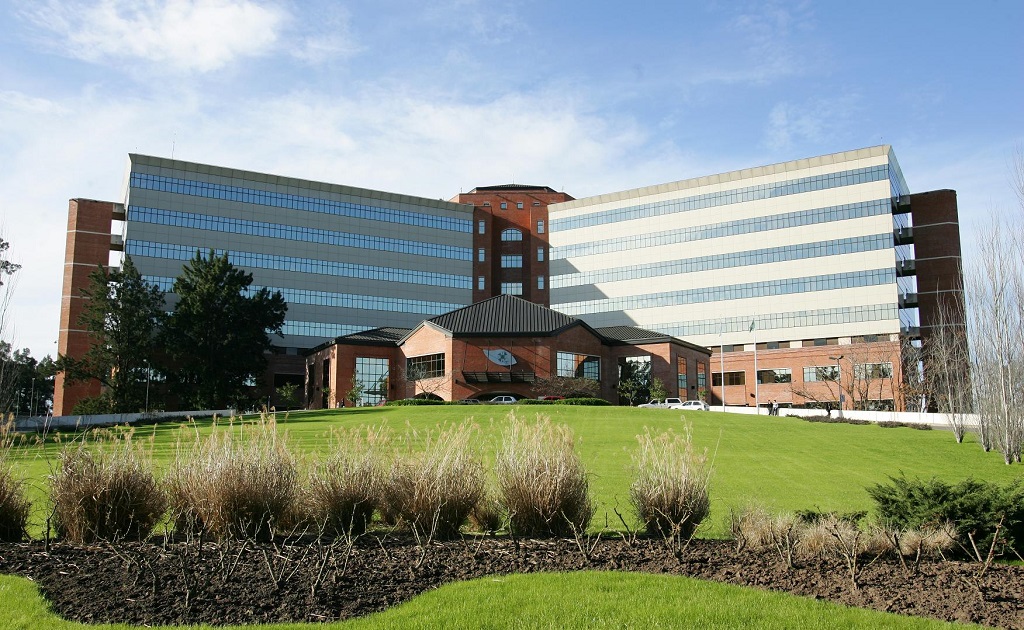
Austral University Hospital, a premier private non-profit teaching hospital in Buenos Aires, operates at the critical intersection of biomedical assistance, research, and education. Since its founding in 2000, the institution has been guided by a mission to search for truth and promote a culture of life through high-complexity care. This mission is stress-tested daily by an intense operational volume, including approximately 63 surgeries per day across nine state-of-the-art operating rooms.
In this environment, the technical infrastructure is not merely a utility; it is a clinical prerequisite. As radiology transitioned into a data-intensive engine of modern medicine, the hospital’s ability to deliver on its mission became increasingly tethered to the scalability of its medical imaging storage.
However, this operational excellence was recently threatened by a looming infrastructure bottleneck. A rapid increase in the amount of imaging data generated by their Picture Archiving and Communication System (PACS), coinciding with supply-chain problems brought on by a global shortage of compute and storage hardware, left them unable to expand their on-premises file storage.
At risk of storage exhaustion, which would disrupt clinical workflows and directly impact patient care, Austral University Hospital realized that the traditional hardware model that had served them for so long was no longer aligned with the urgency of their situation.
The Challenge
In a high-complexity PACS environment, storage capacity is a “zero-fail” requirement. Patient safety depends on the uninterrupted ingestion of new studies and the immediate availability of historical imaging for surgical planning. For Austral University Hospital, storage exhaustion was not an IT inconvenience; it was a looming “hard stop” on clinical continuity.
The IT leadership’s risk assessment identified a two-pronged crisis that dictated an immediate move away from CapEx-heavy hardware models:
- Internal Pressures (The Capacity Cliff): The hospital’s five-node, 200TB Qumulo cluster, the backbone of its Philips PACS environment, was at 89.3% capacity. With imaging data growing at an exponential rate, the team was left with a dangerously thin buffer, risking a disruption of radiology and surgical operations.
- External Pressures (The Procurement Paralysis): A global supply-chain crisis meant the hospital faced a three-month lead time for new hardware to expand their on-premises Qumulo cluster. The additional impact of a concurrent worldwide hardware shortage was the inability to obtain timely, competitive quotes due to price volatility, leaving the physical infrastructure needed to maintain their clinical workflow effectively trapped in a global logistics gridlock.
Given the stakes, the hospital made a strategic pivot toward a cloud-integrated approach that would let them bypass supply-chain shortages and unpredictable pricing and turn directly to the cloud for the capacity they needed.
The Solution
Austral University Hospital chose a hybrid-cloud solution that allowed them to leverage their existing Qumulo investment.
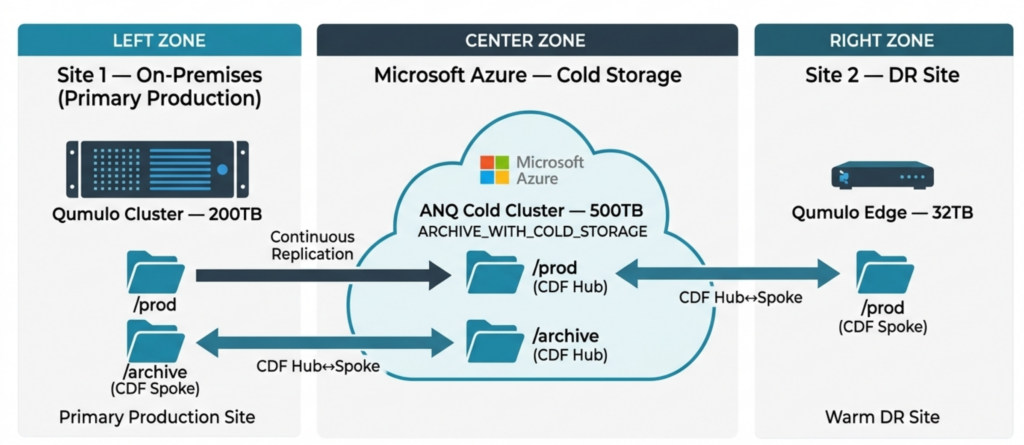
- Architecture: The team deployed Cloud Native Qumulo (CNQ) as a cloud service on Microsoft Azure in conjunction with Qumulo Cloud Data Fabric (CDF), enabling them to connect their on-premises “hub” to a new “spoke” hosted on Azure.
- Deployment Speed: A new three-node CNQ cluster was deployed in approximately four hours, with approximately 500TB of usable capacity available that same day. Contrast that with a long turnaround time just to obtain a reliable quote from their OEM, on top of the 90-day wait for new hardware.
- Pay-as-You-Go Pricing: Even though CNQ could support up to 500TB of capacity immediately, CNQ’s unique architecture enabled the hospital to pay for only the actual capacity consumed, providing a more efficient TCO than CapEx hardware, which costs the same whether it’s used or not.
- Workflow Integration: The solution leveraged the Phillips PACS “Archive Portal” logic. By transparently offloading historical imaging to the cloud-backed tier, the on-premises cluster was freed for high-performance ingestion of new imaging data.
The strategic advantage of this approach lies in its ability to solve an on-premises capacity problem without actually adding physical hardware on-site. By extending the local data center into the cloud, the IT team could “empty” the existing hub, instantly reclaiming space for new patient studies.
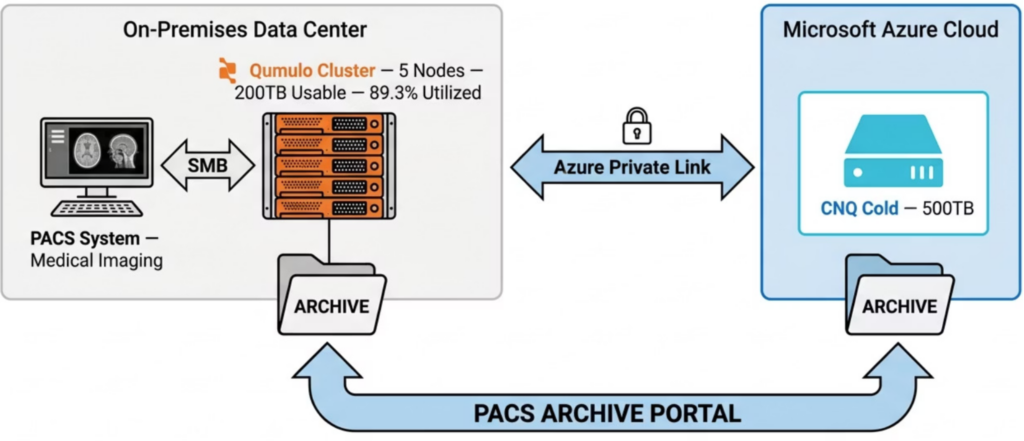
Crucially, all of this was achieved without changing the clinician’s experience; a surgeon in one of the hospital’s operating rooms can still pull a years-old study with seamless transparency.
Business Impact
The immediate benefits of this architectural pivot include:
- Elimination of Risk: The hospital neutralized the threat of operational disruption in radiology by securing capacity in four hours, ensuring that no surgery or diagnosis was delayed due to storage constraints.
- Financial Optimization: Austral University Hospital avoided a costly upfront CapEx layout during a period of market volatility, aligning its costs directly with actual data consumption and preserving capital for other clinical innovations.
- Cloud Agility: The hospital gained 500TB of usable capacity the same day, proving that software-defined storage can neutralize supply chain barriers.
Looking Ahead
Austral University Hospital is evolving its data strategy from simple archiving to a comprehensive Business Continuance model powered by Qumulo:
- Evolution to Hybrid DR: The architecture is transitioning toward a fully cloud-based model, in which even recent imaging data is immediately written to the cloud while remaining instantly accessible to on-premises clinicians. This will enable real-time access to imaging for advanced AI analytics and research in other campuses and sites, ensuring data is an active asset rather than a dormant archive.
- Business Continuance: The team is implementing a “Site 2” (Warm DR Site) using a Qumulo Edge Accelerator to provide continuous access to data hosted on CNQ in the event of an outage at the primary site, delivering a significant upgrade in disaster-recovery capability compared to traditional backups.
- The AI-Ready Blueprint: The success of this architecture serves as a model for data-driven workloads across Azure, Amazon Web Services (AWS), Google Compute Platform (GCP), and Oracle Cloud Infrastructure (OCI), ensuring that medical data is accessible, secure, and ready for the next generation of clinical AI.
By modernizing its data infrastructure and adopting a hybrid-cloud operational model powered by Qumulo, Austral University Hospital has ensured that its medical professionals remain focused on the quality of healthcare in an evolving landscape rather than the management of storage constraints.

Industry:
Healthcare and Research
Use Case:
PACS (high-resolution medical imaging)
Location:
Buenos Aires, Argentina
Company Overview:
Austral University Hospital is a major private non-profit teaching hospital located in Buenos Aires, Argentina. Founded in 2000, it operates as a high-complexity facility with nine operating rooms that provides high-volume surgical care (approx. 63 surgeries per day).
Why Qumulo:
- Imminent storage exhaustion
- Supply chain crisis
- Cloud capacity in the cloud was available immediately
- Seamless archiving of historical data
Benefits:
- Eliminate the imminent risk of operational disruption
- Financial optimization and greater cost efficiency
- Cloud-based capacity and increased agility