For organizations building cloud-native infrastructure on AWS, one challenge consistently rises above the rest: moving from interest to operational confidence.
Most cloud evaluations start the same way: a polished demo, an architecture diagram, or a webinar full of promises about scalability, resilience, and hybrid cloud workflows.
And eventually, every infrastructure team reaches the same question:
“Okay… but how does this actually work in my environment?”
Because slide decks are easy. Operational confidence is harder.
Anyone can present a polished vision of cloud-native infrastructure. The real test is what happens when engineers deploy the environment, scale workloads, test resiliency, integrate with existing workflows, and operate it day-to-day in AWS.
That’s the gap the new Qumulo on AWS Workshop was designed to close.
Built specifically for organizations evaluating or deploying Cloud Native Qumulo (CNQ) on AWS, the workshop gives customers a hands-on way to explore modern file storage using real AWS infrastructure, real workflows, and practical architectural patterns.
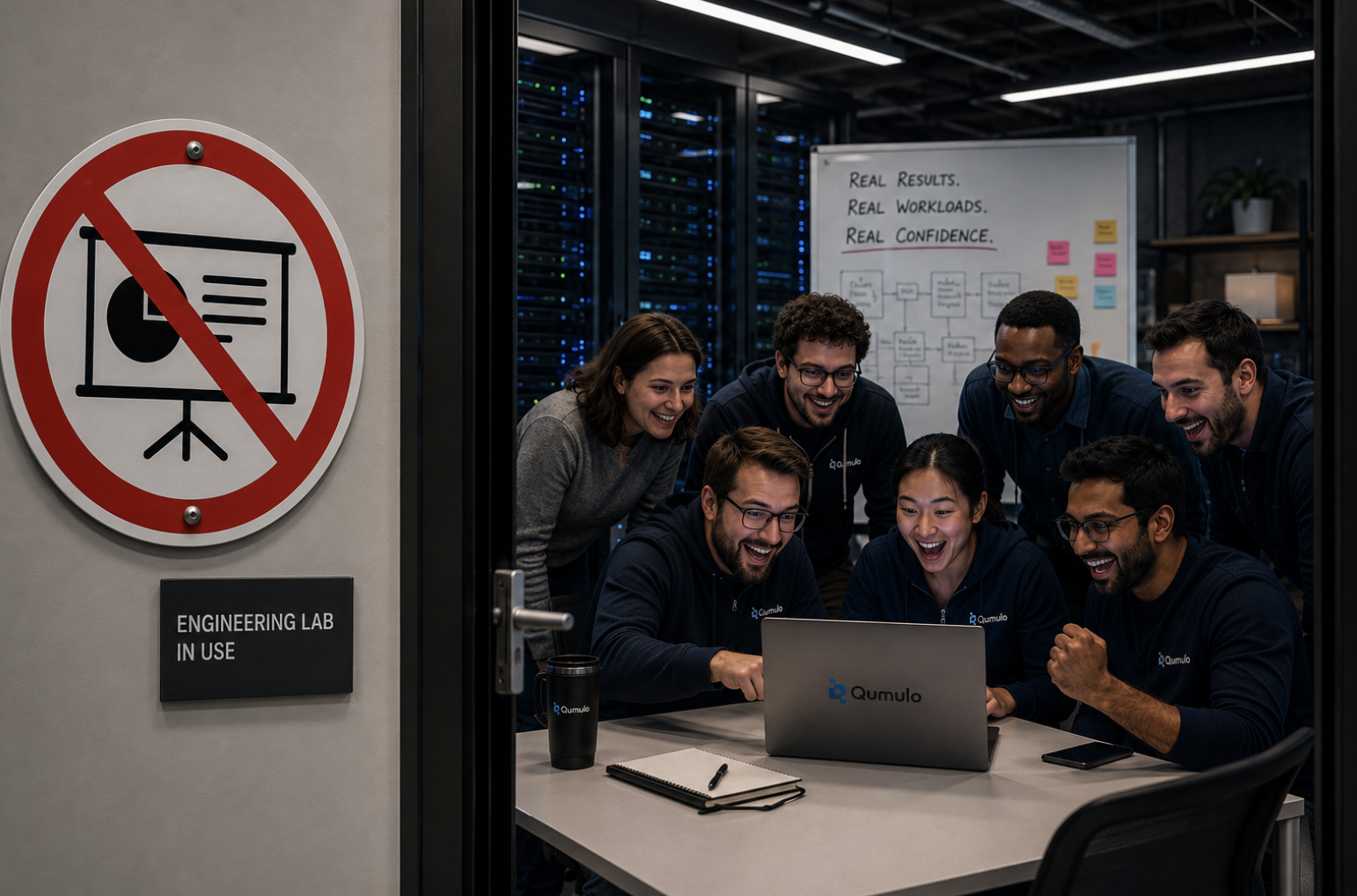
Instead of sitting through another presentation about cloud-native file storage, customers can directly deploy environments, test workflows, explore scaling operations, and validate how CNQ behaves in practice.
More importantly, it does so through one of AWS’s most trusted technical engagement frameworks.
Why This Is Valuable for Customers
At its core, the workshop is designed to help customers make better and faster infrastructure decisions.
Instead of relying on slide presentations or theoretical discussions, customers directly experience how CNQ behaves within AWS. They can deploy environments, test workflows, explore scaling operations, and understand what day-to-day operations actually look like.
In most engagements, the workshop is delivered through AWS Workshop Studio, with Qumulo and AWS jointly leading the session and guiding customers through each section interactively. That model creates an important advantage for customers: there is typically no infrastructure cost required to participate. For organizations sending multiple engineers, architects, or operations teams, this can significantly lower the barrier to hands-on evaluation.
The workshop can also be deployed directly into a customer’s AWS account when deeper customization or internal validation is required, giving teams flexibility tailored to their evaluation goals.
That matters because the biggest questions customers ask about cloud-native file storage are rarely marketing questions. They are operational ones:
- How quickly can workloads scale?
- How does multi-AZ architecture behave?
- What does cloud bursting actually look like?
- How do hybrid workflows operate in practice?
- What does deployment and management feel like day to day?
Those are difficult questions to answer convincingly through demos alone.
A workshop changes that dynamic entirely. Customers move beyond hearing about capabilities and begin validating them firsthand in live AWS environments.
Because Qumulo and AWS solution architects are actively involved throughout the workshop, the sessions are also highly valuable opportunities for customers to discuss their real-world workloads and workflows directly with subject-matter experts. Instead of generic demonstrations, conversations can focus on practical implementation details, architecture considerations, migration planning, and operational concerns specific to the customer’s environment.
The experience is intentionally practical, which is exactly why AWS uses workshops so extensively across strategic accounts, AWS Summits, immersion days, and AWS re:Invent.
Workshops are not treated like traditional marketing assets. To marketing’s credit, they are also among the few assets engineers actually ask to attend.
Why Being First Matters
Qumulo is the first storage partner to publish an official AWS workshop in the AWS catalog. That distinction matters because publishing an AWS workshop requires far more than a standard technology partnership or co-marketing initiative.
From the outside, it would be easy to view this launch as simply another partnership milestone between Qumulo and AWS.
But for customers, it represents something much more meaningful: validation.
AWS workshops are built through deep technical collaboration between AWS and the partner. The architecture must be jointly designed, validated, reviewed for security and operational readiness, and approved through AWS processes. The process can take months and sometimes more than a year.
That means customers are not evaluating a theoretical reference architecture or a polished demo environment. They are exploring workflows, deployment patterns, and operational models that have already been reviewed and operationalized alongside AWS.
It also demonstrates that AWS sees value in enabling customers to evaluate CNQ through one of its highest-trust technical engagement models. As a result, customers can explore CNQ within a framework that AWS field teams already know, trust, and actively use with enterprise accounts.
That reduces friction during evaluations and creates a more natural path for AWS teams and customers to collaborate on real-world cloud infrastructure projects.
And yes, other storage vendors will likely build workshops in the future. But for organizations looking to reduce uncertainty in their cloud evaluation process today, the framework is already validated, the environments are operational, and the workshop is ready to use.
From Weeks of Evaluation to Hours of Hands-On Validation
Our customers’ time is valuable. Customers exploring CNQ on AWS are often trying to validate several things at once:
- cloud-native scalability
- operational simplicity
- performance consistency
- hybrid cloud mobility
- resilience across AWS environments
- integration with existing workflows
In a traditional evaluation process, these discussions can stretch across weeks of presentations, follow-up meetings, and fragmented technical reviews.
A workshop compresses that experience into a focused, hands-on session where teams can interact directly with the environment.
Participants can deploy CNQ, explore scale-out and scale-in operations, evaluate single-AZ and multi-AZ architectures, and understand how Cloud Data Fabric capabilities support distributed workloads across AWS.
Instead of imagining how the architecture works, customers experience it directly.
The Value Extends Beyond Storage Teams
One of the most powerful aspects of the workshop format is that it naturally brings multiple teams together.
A CNQ workshop often includes:
- cloud infrastructure teams
- storage architects
- automation engineers
- networking teams
- security stakeholders
- platform engineering groups
That cross-functional visibility is increasingly important because modern AWS projects are rarely isolated infrastructure decisions.
A media and entertainment company evaluating rendering workflows may have storage teams, cloud platform engineers, and pipeline owners participating together. A healthcare organization exploring imaging pipelines may include infrastructure architects, operations teams, and compliance stakeholders in the same session.
Because the workshop combines hands-on labs with interactive discussion and guided presentations from Qumulo and AWS, it creates space for teams to ask questions in real time, discuss operational considerations internally, and evaluate how the solution fits their specific workflows and organizational requirements.
And that changes the nature of the engagement.
Instead of debating theoretical capabilities, teams begin discussing deployment strategies and implementation patterns specific to their own environments.
A Better Way to Explore Cloud-Native File Storage
Because workshop environments typically remain available for a limited time after the live session, participants can continue testing workflows, completing labs, and exploring the environment at their own pace for an additional day or two.
The experience is also intentionally interactive. Led jointly by Qumulo and AWS, the workshop combines hands-on labs with guided discussion, technical presentations, and real-time conversations throughout the session. That format allows customers not only to test the technology directly but also to ask questions, discuss operational considerations internally, and evaluate how CNQ fits their specific workflows and business requirements.
The result is a balance between structured learning and practical experimentation, which is exactly why AWS workshops have become such an effective customer engagement model.
Seemingly Bragadocious but with Real Customer Benefits
For customers evaluating or deploying Cloud Native Qumulo on AWS, the workshop represents far more than a partnership milestone or tooting our own horn. (Although it’s nice to do that if you have something worth celebrating! )
It is a practical way to reduce uncertainty, accelerate evaluations, and gain hands-on confidence in how CNQ operates inside AWS. It provides clarity.
And because it is built within one of AWS’s most trusted technical engagement frameworks, customers are not just evaluating a product. They are evaluating real operational patterns that are jointly validated by AWS and Qumulo.
That is what makes this launch important.
Not simply because Qumulo was first, but because customers now have a faster, more transparent, and more practical way to understand what cloud-native file storage can look like in production on AWS.