Strictly as a fictional exercise in bad infrastructure decisions…
SPOILER ALERT! Stop reading if you haven’t seen Rogue One: A Star Wars Story.
On second thought, this movie came out a decade ago; that’s on you for not seeing it. BTW, Frodo destroys the ring in Mordor, Andy Dufresne escapes from Shawshank, and Tony Stark snaps his fingers to set the world right again. Now, where was I going with this? (Stay on Target, Stay on Target)
Oh, right, there are a few moments in the Star Wars universe more catastrophic for the Galactic Empire than the events of Rogue One: A Star Wars Story.
After spending unimaginable resources building the Death Star, the Empire’s ultimate weapon, the entire project collapses because a small Rebel team manages to steal one thing:
the plans.
Not a fleet.
Not a superweapon.
Not a battle station.
A single archive cartridge.
A ragtag group of rebels and a jailbroken droid infiltrate Scarif, the Empire’s top-secret secure archive planet. They break into the Imperial archive vault, retrieve the Death Star schematics hidden under the codename Project Stardust, and transmit them to the Rebel fleet. Those stolen plans eventually make their way to Princess Leia, then to R2-D2, and finally to Luke Skywalker.
The result?
One thermal exhaust port.
One proton torpedo.
One very angry Darth Vader.
I’m not saying I’m actively rooting for the Empire to win, but…what if they had designed Scarif differently? What if the CTO and acting comptroller of the Empire weren’t such nerf herders about their data storage?
What if, instead of relying on a removable archival data tape, they had built their data infrastructure on something like Qumulo Stratus?
The answer is simple:
Darth Vader would have loved it. After a quick proof of concept, I’d bet a purchase order would have landed on Emperor Palpatine’s desk almost immediately. His response? A cold, decisive “Do it!”, probably signed before the Rebels even reached Scarif.
Not sure how you feel about this?
Gooood! I can feel your anger. (Said in a sinister, raspy, and guttural croak that embodies malicious glee)
The Empire’s Real Failure Wasn’t Security, It Was Data Architecture
Scarif looked secure.
It had:
- planetary shields
- biometric access
- air-gapped archives
- elite Imperial guards
- a massive data vault holding the Empire’s most sensitive secrets
From a physical security perspective, it was impressive. But underneath all of that was a critical flaw: the Death Star plans existed as a physically retrievable object. A single data tape.
In a galaxy where Boba Fett, the most infamous bounty hunter around, can apparently write off his Z-6 jetpack as a business expense, you’re telling me an entire industry prioritized designing jetpacks before the Galactic Empire figured out how to properly protect its most valuable asset: its data?
Even an assassin droid like IG-88 gets it. It had the decency to self-destruct rather than risk sensitive information falling into the wrong hands. You would think the Empire might have applied that same logic to the schematics for its sensitive information. Nope, instead, they stored the Death Star plans on one removable archive tape and acted surprised when someone walked off with it. Apparently, the assassin droid had a stronger security posture than the Imperial archive team.
That meant the Rebels didn’t need to hack the Empire. They just needed to steal the cartridge. That’s not a security problem. That’s a storage architecture problem.
Now imagine those same plans encrypted with a 256-bit FIPS-compliant algorithm, making them nearly impossible to read, while also being sharded and distributed across hundreds of locations, making them nearly impossible to collect and reassemble. Suddenly, Rogue One stops being a smash-and-grab mission and starts looking a lot more like an impossible heist.
Enter Qumulo Stratus
Thankfully, in the real world, Qumulo helps organizations protect critical data for healthcare, research, media, and public sector teams—not moon-sized battle stations.
Qumulo Stratus is a fully disaggregated, shared-nothing data platform designed to bring cloud-native architecture into private data centers.
In simpler terms:
It eliminates exactly the kind of weakness that destroyed the Empire. Instead of storing critical information on removable archival media, Stratus separates storage into two distinct layers:
Layer 1: Stratus DataCore
This is the durable storage layer. Think of it as the modern replacement for Scarif’s vault.
It stores only:
- compressed data
- encrypted data
- opaque storage objects
Even the root administrator cannot access unencrypted tenant data because the storage layer itself never sees plaintext. That’s a major difference. Because if Jyn Erso, leader of the rebels, “steals”* the storage media, she gets encrypted nonsense. Not Death Star plans. Not reactor schematics. Not the thermal exhaust flaw. Just useless ciphertext.
*Rebel translation: borrows for the greater good of the galaxy, which I concur with.
Layer 2: Stratus Accelerators
These are the compute nodes.
They handle:
- file system operations
- protocol access (NFS, SMB, S3), these are the protocols you are looking for.
- encryption and decryption
- tenant access controls
- cryptographic key ownership
Most importantly, they contain no persistent user data. They are stateless. So even if the Rebels compromise one temporarily, there’s no “master tape” to run away with.
The Data Architecture That Could Have Changed an Entire Franchise
Because Qumulo Stratus removes the exact vulnerability that drove Vader into that dark hallway scene, where he was left using a desperate Force choke and every ounce of the dark side to claw back a single tape loaded with the Empire’s most sensitive data. If that single point of failure had been addressed, and I mean the mismanaged data, not the exhaust port, the other famous single point of failure, none of this would have happened. No stolen plans. No desperate Rebel handoff. No trench run over the Death Star. In fact, there wouldn’t be an additional 11 major theatrical releases, countless spinoffs, or entire generations arguing over the best trilogy (4, 5, 6). So, for that, perhaps we should be grateful that the Empire chose the single archived data tape.
Although, to be fair, we would probably all survive just fine without the Star Wars Holiday Special with those long, unsubtitled Wookiee conversations (1978). And this is coming from a person who owns “Christmas In the Stars,” the definitive Star Wars Christmas Album with that absolute banger of a hit, “What Can You Get A Wookie For Christmas (When He Already Owns A Comb?)”.

All that to say, I definitely would not want to be on the receiving end of that Imperial performance review. After all, we must remember Vader is far more forgiving than the Emperor or your CEO when a critical project misses its deadline.
Without Stratus, the Rebel strategy was simple: “Steal the tape.”
With Qumulo Stratus, that mission becomes exponentially harder: “Break cryptographic isolation inside a zero-trust architecture.” Instead of a simple robbery, Rogue One becomes a far more complex cyber-physical breach requiring key compromise, privileged access, insider betrayal, Accelerator takeover, and infiltration of the encryption domain. That is significantly harder than pulling a tape and running.
If Stratus had been installed, Vader might have delivered this warning much earlier instead of waiting until Return of the Jedi: “You may dispense with the pleasantries, Commander. I’m here to put you back on schedule.”
Cryptographically Assured Multi-Tenancy: An Architect’s Dream (Even in the Empire)
Qumulo Stratus uses something called: Cryptographically Assured Multi-Tenancy
Each tenant gets:
- dedicated Accelerators
- unique encryption keysets
- isolated security boundaries
The shared DataCore stores only encrypted blobs, and even DataCore administrators cannot view tenant files. Imagine applying that to the Empire’s separate divisions: the Kyber crystal processing facility, Detention block AA-23, Garbage compactor 3263827, and Galen Erso’s personal “Secret Projects” folder. All running on the same infrastructure, but fully isolated from one another. Even if one team is compromised, the others remain protected. That’s not just good architecture. That’s Sith-level paranoia.
No More “Noisy Neighbor” Problems
There’s another reason Vader would love Stratus: performance isolation.
Legacy systems force multiple workloads to compete for shared compute resources. That means one heavy workload can slow everyone else down. Not ideal when your giant spherical battle station depends on engineering deadlines. Stratus solves this by giving each workload dedicated Accelerators. One tenant’s heavy usage cannot affect another.
So, the Death Star construction can run at full speed without slowing down Star Destroyer logistics, intelligence operations, or payroll. Even the Empire deserves good QoS.
The Hallway Scene Might Have Never Happened
Let’s be honest. Everyone remembers Vader in the hallway. It was the last scene in Rogue One and the first scene in A New Hope.
Lightsaber.
Darkness.
Absolute mayhem.
But with Stratus? That scene may have never happened. Because there would be no physical plans to hand off, no cartridge, no stolen data tape.
(Takes a deep breath)
The Hammerhead Corvette never rams the Star Destroyer. The planetary shield remains closed. The data migration never leaves Scarif. Admiral Raddus (not to be confused with Ackbar) never downloads the plans. Leia never uploads her holographic plea for help into R2-D2. The escape pod is never jettisoned. The Jawas would still sell a droid with a bad motivator. Luke never removes the restraining bolt. Obi-Wan Kenobi remains Old Ben. Luke never learns the ways of the Force; he helps with the harvest. The Death Star survives, and certainly no Ewok after-party.
(Exhales)
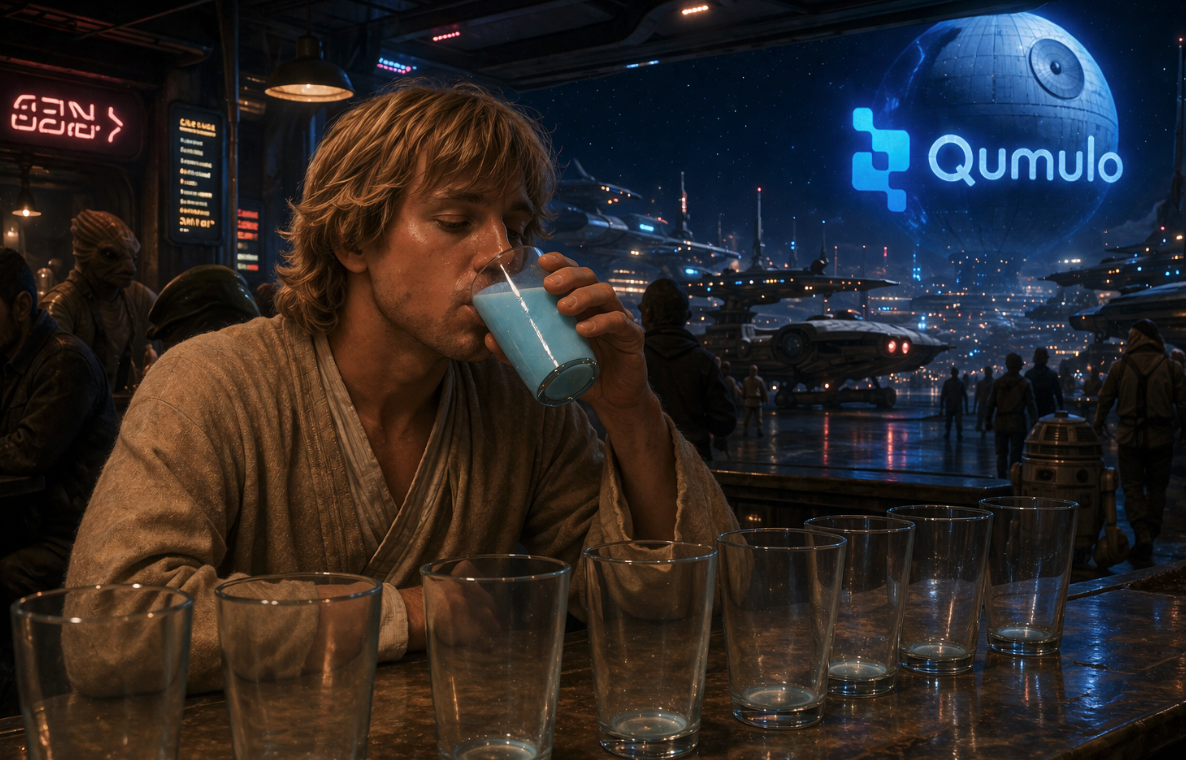
From a pure infrastructure perspective, the Empire created a catastrophic single point of failure. If the Empire had installed Qumulo Stratus, Luke would likely be back on Tatooine, shooting womp rats not much bigger than two meters, drinking too many glasses of blue milk, and hanging out at Tosche Power Station after a long day at the moisture farm.
And Vader? He gets to keep his admirals…probably.
Qumulo Stratus turns vulnerable archive storage into a zero-trust cryptographic infrastructure. It removes the single point of failure that doomed the Empire. It prevents portable data theft. It eliminates noisy neighbors. It enforces true tenant isolation. And it makes stealing the Death Star plans exponentially harder- dare I say, impossible.
Thankfully, most customers are trying to protect research data, healthcare records, and media pipelines, not planetary superweapons. But the lesson is the same: organizations are working to reduce risk, lower costs, and improve outcomes with the help of the best modern data architecture in the galaxy, the Qumulo Data Platform. And for those still incredulous, I find your lack of faith disturbing.